Monday, 5 March 2012

Chocolate History Timeline


For over 3000 years, chocolate, like gold, has had universal appeal
2000 BC, Amazon: Cocoa, from which chocolate is created, is said to have originated in the Amazon at least 4,000 years ago.

Sixth Century AD: Chocolate, derived from the seed of the cocoa tree, was used by the Maya Culture, as early as the Sixth Century AD. Maya called the cocoa tree cacahuaquchtl… "tree," and the word chocolate comes from the Maya word xocoatl which means bitter water.

300 AD, Maya Culture: To the Mayas, cocoa pods symbolized life and fertility... nothing could be more important! Stones from their palaces and temples revealed many carved pictures of cocoa pods.
600 AD, Maya Culture: Moving from Central America to the northern portions of South America, the Mayan territory stretched from the Yucatán Peninsula to the Pacific Coast of Guatemala. In the Yucatán, the Mayas cultivated the earliest know cocoa plantations. The cocoa pod was often represented in religious rituals, and the texts their literature refer to cocoa as the god’s food
Chocolate has impacted the ways in which some humans worshiped, and expressed their values
1200, Aztec Culture: The Aztecs attributed the creation of the cocoa plant to their god Quetzalcoatl who, descended from heaven on a beam of a morning star carrying a cocoa tree stolen from paradise. In both the Mayan and Aztec cultures cocoa was the basis for a thick, cold, unsweetened drink called xocoatl… believed to be a health elixir. Since sugar was unknown to the Aztecs, different spices were used to add flavor, even hot chili peppers and corn meal were used!
Aztecs believed that wisdom and power came from eating the fruit of the cocoa tree, and also that it had nourishing, fortifying, and even aphrodisiac qualities. The Aztec emperor, Montezuma, drank thick chocolate dyed red. The drink was so prestigious that it was served in golden goblets that were thrown away after only one use. He liked it so much that he was purported to drink 50 goblets every day!
The cocoa beans were used for currency… records show that 400 cocoa beans equaled one Zontli, while 8000 beans equaled one Xiquipilli. When the Aztecs conquered tribes, they demanded their payment in cocoa! By subjugating the Chimimeken and the Mayas, the Aztecs strengthened their supremacy in Mexico. Records dating from 1200 show details of cocoa deliveries, imposed on all conquered tribes.

1492, Columbus Returns in Triumph From America: King Ferdinand and Queen Isabella were presented with many strange and wonderful things… the few dark brown beans that looked like almonds didn’t get a lot of attention.
1502, Columbus landed in Nicaragua: On his fourth voyage to America, Columbus landed in what is now called Nicaragua. He was the first European to discover cocoa beans being used as currency, and to make a drink, as in the Aztec culture. Columbus, who was still searching for the route to India, still did not see the potential cocoa market that had fallen into his lap.
1513, A Slave is Bought for Beans: Hernando de Oviedo y Valdez, who went to America in 1513 as a member of Pedrarias Avila's expedition, reports that he bought a slave for 100 cocoa beans. According to Hernando de Oviedo y Valdez 10 cocoa beans bought the services of a prostitute, and 4 cocoa beans got you a rabbit for dinner.
At this time, the name of the drink changed to Chocolatl from the Mayan word xocoatl [chocolate] and the Aztec word for water, or warm liquid.
1519, Hernando Cortez Begin a Plantation: Hernando Cortez, who conquered part of Mexico in 1519, had a vision of converting these beans to golden doubloons. While he was fascinated with Aztec's bitter, spicy beverage [he didn’t like the cocoa drink], he was much intrigued by the beans’ value as currency. Later, Cortez established a cocoa plantation in the name of Spain… henceforth, "money" will be cultivated! It was the birth of what was to be a very profitable business.

1528, Chocolate Arrives in Spain: Cortès presented the Spainish King, Charles V with cocoa beans from the New World and the necessary tools for its preparation. And no doubt Cortès taught him how to make Chocolatl.
Cortez Inspires a Major Breakthough: Cortez postulated that if this bitter beverage were blended with sugar, it could become quite a delicacy. The Spaniards mixed the beans with sugar, vanilla, nutmeg, cloves, allspice, and cinnamon. The results were tantalizing, coveted, fashionable, and reserved or the Spanish nobility which created a demand for the fruits of his Spanish plantations. Chocolate was a secret that Spain managed to keep from the rest of the world for almost 100 years!
It is no secret that Chocolate has enjoyed a reputation as an aphrodisiac ever since Conquistadores first became aware of the "pagan" ways of the Aztecs [who regarded chocolate as a medicine, but probably not as an aphrodisiac.]
1544, Dominican Friars Get into the Swing: Dominican friars bring a delegation of Mayans to meet Philip. Spanish monks, who had been consigned to process the cocoa beans, finally let the secret out. It did not take long before chocolate was acclaimed throughout Europe as a delicious, health-giving food.
The beans were still used as currency. Two hundred beans bought a turkey cock. One hundred beans was the daily wage of porter, and would buy a hen turkey or a rabbit (the price has really escalated in 30 years! Three beans could be traded for a turkey egg, a new avocado, or a fish wrapped in maize husks. One bean bought a ripe avocado, tomato, or a tamale.
1569, The Roman Church Takes a Serious Look at Chocolate: Pope Pius V, who did not like chocolate, declared that drinking chocolate on Friday did not break The Fast.
1579, English Buccaneers Burn Currency: After taking a Spanish ship loaded with cocoa beans, English Buccaneers set it on fire thinking the beans were sheep dung.
1585, Chocolate Goes to Market: The first shipment of beans intended for the market makes it to Spain.

1587, Another Ship Goes Down: When the British captured a Spanish vessel loaded with cocoa beans, the cargo was destroyed as useless.
1609, Chocolate is Lauded in Literature: The first book devoted entirely to chocolate, "Libro en el cual se trata del chocolate," came from Mexico.
1615, Chocolate Comes With the Dowery: Ann of Austria, daughter of Philip II from Spain, introduced the beverage to her new husband, Louis the XIII, and his French court, too.
1625, Cocoa Beans are Currency in Spain too: 200 small cocoa beans were valued at 1 Spanish real, or 4 cents.
1643, The French Court Embraces Chocolate: When the Spanish Princess Maria Theresa was betrothed to Louis XIV of France, she gave her fiancé an engagement gift of chocolate, packaged in an elegantly ornate chest.
Chocolate was extremely popular with Louis XIV and the members of his Court at Versailles. Louis XIV, The Sun King, reigned for over 74 years [1643 to 1715] and is considered to be one of the greatest absolute monarchs. His foresight lead him to appoint Sieur David illou to manufacture and sell chocolate, which not only created a new income stream, but also it is said to have inspired erotic pleasures. It was well known that in Louis’ 72nd year he was making love to his wife twice a day… Chocolate?
Chocolate Mania in Paris: The chocolate craze which now included candy took hold in Paris and then conquered the rest of France.
Chocolate’s reputation as an aphrodisiac flourished in the French courts. Art and literature was thick with erotic imagery inspired by chocolate. And the Marquis de Sade, became proficient in using chocolate to disguise poisons! Casanova was reputed for using chocolate with champagne to seduce the ladies.
Madame de Pompadour was advised to use chocolate with ambergris to stimulate her desire for Louis XV… but to no avail. Madame du Barry, reputed to be nymphomaniacal, encouraged her lovers to drink chocolate in order to keep up with her.
1657, Even London Succumbs: London's first chocolate shop is opened by a Frenchman. London Chocolate Houses became the trendy meeting places where the elite London society savored their new luxury. The first chocolate house opened in London advertising "this excellent West India drink."
1662, Rome Takes Another Look: As chocolate became exceptionally fashionable,The Church of Rome took a second look at this bewitching beverage. The judgment: "Liquidum non frangit jejunum," reiterated that a chocolate drink did not break the fast. But eating chocolate confections didn’t pass muster, until Easter. Is this where the Easter Bunny makes an entrance?
1670, One Man Takes a Stand: Helmsman Pedro Bravo do los Camerinos decides that he has had enough of Christian voyages of exploration and settles in the Philippines, where he spends the rest of his life planting cocoa, thus laying the foundations for one of the great plantations of that time.
1671, All Troubles Have a Silver Lining: Sometimes people just don’t see it…this time creativity prevailed! As the story goes, a bowlful of almonds is dropped, and the angry chef tries to "box the ears" of his kitchen boy… but instead he spills a pan full of hot, burnt sugar over the almonds. Meanwhile the renowned gourmet, Duke of Plesslis-Praslin, is waiting for his dessert!
His personal chef turns anger in to creative energy, and serves the Duke almonds coated of cooled burnt sugar. The Duke is not only delighted… he is also inspired to give his name to this nouveau sweet. Today we call this confection "praline," but there is no doubt of the origin!

1674, A Trendy Coffee House Takes Chocolate To New Horizons: An Avant Guard, London Coffee House called At the Coffee Mill and Tobacco Roll, goes down in the annals of history for serving chocolate in cakes, and also in rolls… in the Spanish style.
1677, Brazil Gets into The Market: By Royal Decree, November 1, 1677, Brazil [later to achieve an important position in the world market] establishes its first cocoa plantations in the State of Par .
1697, The mayor of Zurich, visits Brussels: Heinrich Escher, mayor of Zurich, drinks chocolate in Brussels and introduces the awe-inspiring concoction to his friends at home… nothing he has ever tasted is even slightly like this brew!
1704, The Germans Impose a Tax on Chocolate: Chocolate makes its appearance in Ger many, and Frederick I of Prussia reacts by imposing a tax. Anyone wishing to pay homage to its pleasures has to pay two thalers for a permit.
1711, Chocolate Migrates to Vienna: Emperor Charles VI transfers his court from Madrid to Vienna and along with his Court, comes chocolate.
1720, Coffee Houses Propagate Trendy Chocolate: Italian Chocolatiers from Florence and Venus, now well versed in the art of making chocolate, are welcomed to France, Germany and Switzerland.
1730, Hand Methods of Manufacture Gave Way to Mass Production: The transition was hastened by the advent of a perfected steam engine, which mechanized the cocoa grinding process. By 1730, chocolate had dropped in price from three dollars or more per pound to within financial reach of all.
1747, Frederick III of Prussia forbids hawking: Especially the hawking of chocolate! In fact, Frederick prohibited chocolate in his realm. In where Chocolate flourished, It’s high price ensured that only the wealthy could indulge.
1755, America Discovers Chocolate: Diligently forging their concept of Democracy, Americans take time out to discover chocolate.
1765, First Chocolate Factory In the USA: The production of chocolate proceeded at a faster pace than anywhere else in the world. It was in pre-Revolutionary New England.
1780, Spain Was First: The first machine-made chocolate is produced in Barcelona.
1792, A Factory Opens in Berlin: In Germany, the Josty brothers from Grisons open a confectioner's shop and make a hit selling Swiss Chocolate… and they open a chocolate factory in Berlin.
1797, Don’t Leave Home Without Chocolate: As Johann Wolfgang von Goethe tours Switzerland, he insists on having Chocolate available at all times… and a chocolate pot.
1800, Chocolate is an Industry: Antoine Brutus Menier built the first industrial manufacturing facility for chocolate.

1810, Venezuela's Dominates the Industry:. A survey shows that Venezuela produces half of the world's chocolate. And 1/3 is consumed by the Spaniards.
1819, The Swiss Invest in a Chocolate Factory: In a former mill near Vevey, Fran‡ois-Louis Cailler, who had learned the secrets of the chocolate trade in Italy founds his first factory. As cocoa plantations spread to the tropics in both hemispheres by the 19th century, the increased production lowered the price of the cocoa beans and chocolate became a popular and affordable beverage.
Secret techniques in blending and roasting beans,
traditional family recipes and creative interpretations,
and innovative candy making techniques
have been handed down from generation to generation.
1822, The Cocoa Tree becomes an Ornamental Plant: off the west coast of Africa on the Principe Island in the Gulf of Guinea, Ferreira Gomes [from Portugal] introduces the cocoa tree as an ornamental plant.
1828, The Cocoa Press is Invented: The Press lead to reduced prices and helped to improve the quality of the beverage by squeezing out part of the cocoa butter. Drinking chocolate had a smooth consistency and a more pleasing taste.

1830, The Drink Became a Confection: Solid eating chocolate was developed by J. S. Fry and Sons, a British chocolate maker.
1847, An English Company Introduced Fondant Chocolate: This smooth and velvety chocolate almost completely replaced the old coarse grained chocolate.
1849, Cadbury Brothers Exhibited Chocolate: The exhibition was at Bingley Hall at Birmingham, England.
1851, Marks a First for Americans: Queen Victoria’s husband, Prince Albert orchestrated The Exposition in London. It was the first time citizens of the United States were introduced to bonbons, chocolate creams, hard candies (called "boiled sweets"), and caramels.
1853, Heavy Import Duties Are Reduced: Once English duties made Chocolate a luxury for the wealthy, now the doors were open, allowing a number of cocoa and drinking chocolate manufacturers to get into the business

1857, Ghana Develops into an Important Producer: A Portuguese Baron of Agua Iz, takes the cultivation of cocoa from Principe Island to a neighboring island, Sao Thome, and then to the African continent. Members of the Basle Mission in Ghana encourage the growth of this emerging crop, and small to medium farmers turn Ghana into one of the most important producers.
1875, Milk Chocolate Comes of Age: After eight years of experimentation, Daniel Peter from Switzerland puts the first milk chocolate on the market.
1879, Chocolate Literally Melts in Your Mouth: Rodolphe Lindt of Berne, Switzerland, invented "conching", a means of heating and rolling chocolate to refine it. After chocolate has been conched for 72 hours and has more cocoa butter added to it, chocolate becomes "fondant" and it melts in your mouth!

1900, Switzerland Takes the Leadership Role: Spain, where chocolate was first introduced to Europeans, falls far behind. Germany consumes the most per head, followed by the United States, France and Great Britain.
1910, The Swiss Reputation for Wonderful Chocolate is Undisputed: Bolstered by an unbroken series of medals at international exhibitions, Swiss Chocolate, like bratwurst, rosti and fondue, is elevated to a national dish.

1913, A new Star is Born: Jules Sechaud of Montreux of Switzerland introduced the process for filling chocolates.
1923, The CMA was Established: The Chocolate Manufacturers Association of the United States of America (CMA) was organized in.
1925, Cocoa is Big Business: The New York Cocoa Exchange, located at the World Trade Center, was begun so that buyers and sellers could get together for transactions.
1938, World War II: The U.S. government recognized chocolate's role in the Allied Armed Forces. It allocated valuable shipping space for the importation of cocoa beans which would give many weary soldiers the strength to carry. Today, the U.S. Army D-rations include three 4-ounce chocolate bars. Chocolate has even been taken into space as part of the diet of U.S. astronauts.
BY: Nageswarie, Rajeswary, Kuganesh, Anita Raj

Hungry Ghost Festival - Malaysia


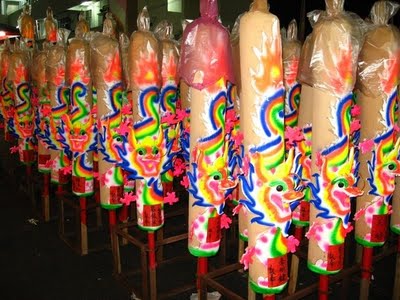
      Hungry Ghost Festival falls on the 7th moon, 15th day of the Chinese Lunar Calendar, making it on the 30th August for 2004 and 19th August for 2005. The build up to this festive date begins roughly a week before. Chinese Opera's and Chinese Puppet Shows are put together for audiences - the living and the non-living alike, at Temples and certain Chinese Associations for a week prior to the big day. These performances are more rampant in towns and villages that are more Chinese (as in race) dominated, like in Penang, Perak, Malacca etc. On a particular visit to a small village close to the Kuala Gula Sanctuary in Perak some years back, we found a Chinese Opera performance in the grounds of a large Taoist Temple. As these performances are open to public, we innocently seated ourselves at the front row . After a short moment, villagers started to fill up the back row seats. Thinking that strange as to why no one chose the front few rows, we happily sat at our chosen spots supposedly the best seats around - only to find out that those seats were reserved for the 'visiting ghosts'!

     There are many rituals and beliefs in the religion that sometimes even baffles believers but for festivals like the Hungry Ghost is typical of Chinese religions, having materialised from a convergence of strains of Buddhist, Confucian, Taoist and traditional religious teachings.

     The Hungry Ghost Festival originated during the Buddhist fusion with classical Chinese filial piety. However, with the introduction of Buddhism to the Chinese came a clash of beliefs. Buddhism, upon entering China, immediately faced the opposition of Confucian filial piety. According to Buddhism, one would have to leave one's home and family in favor of celibacy and begging, which would mean having to relinquish all ancestral commitments. Confucianism on ther other hand, emphasises on filial piety and honouring of ancestors. Hence, Sanskrit sutras were reinterpreted to include obedience to family and upholding of family traditions. The maintenance of such task is passed onto the male heir of the family tree.

      For those with inquisitive minds may be wondering why then is the festival named Hungry Ghosts? Taoists believe that the soul contains elements of both yin and yang. The yin of the sold is called kui (demon) and the yang is named shen (spirit). At death the kui should return to the earth and the shen remains in the grave, family shrine and the other world. If the dead relative's soul is neglected by the family, it will persist as kui, eventually bringing problems to the living. The kui are therefore categorised as hungry ghosts and ancestors are categorised as shen. As the Chinese Spirit World is believed by followers to be in parallel with the living world, spirits have the same basic needs such as food, clothing and sometimes even material comforts that were once enjoyed in the living world. However, this spirit world also exists homeless and hungry souls. These souls are percieved as spiritual beggars who are driven by jealousy of the living hence are deemed to cause mischief in the realm of the living.
   With this in mind, the Hungry Ghost Festival not only pays homage to ancestors but to all other neglected souls roaming in between worlds. Just as most would not invite a beggar into their homes, the same goes for spiritual beggars. Food for these homeless souls are placed outside and sometimes prayer sessions are conducted. The feast usually consist of a variety of meat and delicacies. Some believers even lay out cigarrettes, beer etc for them.

BY: Nageswarie, Rajeswary, Kuganesh, Anita Raj

Billionaire Ananda Krishnan plans to sell satellite firm Measat-report


SINGAPORE: Malaysian tycoon Ananda Krishnan plans to sell his stake in satellite operator Measat Global as part of asset sales that could raise around $3.5 billion, Singapore's Straits Times newspaper reported on Wednesday, citing a banking sources.
Talks about a sale started in late 2011, and could involve Saudi satellite firm Arabsat taking a strategic or even majority stake in the Malaysian satellite firm, the paper cited the source as saying.
However, the Straits Times said control of Measat by Arabsat could be difficult as Malaysia has a 40 percent cap on foreign ownership of strategic domestic assets.
The report comes shortly after Krishnan put his entire power portfolio up for sale, with Standard Chartered hired to manage the transaction of about a dozen power plants.
The deal has so far attracted 12 bids, Malaysia's Star newspaper reported on Saturday, with Saudi Water & Electricity Co submitting the top bid of 10.85 billion Malaysian ringgit ($3.60 billion). - Reuters
BY: Nageswarie, Rajeswary, Kuganesh, Anita Raj

Heart Trouble: Warning Signs of a Heart Attack


     According to the American Heart Association, there is a heart attack every 34 seconds. So if you think it can’t happen to you or a loved one, think again.A heart attack occurs when oxygenated blood is blocked from a portion of the heart. Because our heart needs blood to operate properly, a blockage results in that portion of the heart beginning to die. This obviously becomes a life-threatening situation. Blockages occur when plaque builds up in your coronary arteries. These arteries supply the blood to your heart. This condition is called coronary heart disease. This process happens over time and if it’s not treated, then plaque build up can burst, causing blood clots to form over the waxy buildup. This can lead to partial or total blockages.

According to the American Heart Association, signs of a heart attack include:


·     Chest discomfort and tightness. Also included are heaviness, pressure, aching, numbness or squeezing that can last for several minutes or go away and come back.
  •  Upper body pain or discomfort. Pain in the one or both arms, neck, back, jaw or stomach.
  • Shortness of breath. This can happen before or during chest discomfort.
  • Cold sweats, nausea, or vomiting.
     
    While heart attacks are a leading killer for both men and women in the United States, women can experience different symptoms of a heart attack. Both men and women report chest discomfort as a primary sign of a heart attack, however, women are more likely to have a heart attack without feeling any chest discomfort. Some of the symptoms women can experience are lightheadedness, neck, jaw, shoulder discomfort, nausea, shortness of breath, and sweating. Another common symptom for women is unusual or extreme fatigue.


     Many women are shocked when they understand that they are having a heart attack because many of these symptoms are associated with the flu or indigestion.
It’s important to note that everyone is different and may experience a variety of symptoms.

     Most people don’t experience the dramatic chest grabbing fall to the floor scene that we’ve all seen in the movies. Symptoms of a heart attack can come on slowly. If you suspect you are having a heart attack, you should call 911. Don’t wait! Precious minutes could be the difference between life and tragedy.

  BY: Nageswarie, Rajeswary, Kuganesh, Anita Raj

- 6 smartphone features that you probably don’t need -

Going phone shopping? Don't get suckered into these features by upsale-crazed carrier reps
Need a new smartphone? Thanks to manufacturers and carriers who will stop at nothing to have you sign on that magical dotted line at the bottom of a 2-year contract, it can be nigh impossible to tell what you should actually care about when it's time to shop for a new phone. Carriers in particular have a tendency to play up select features while downplaying the stuff that matters, making it easy to get tangled up in the intricate web of marketing buzzwords and pseudo-selling points that any company rep would be happy to assault you with. Read on for our tips on some smartphone features that might be worth skipping.

Do you need a big data plan?
1. The biggest data planYou're on your smartphone constantly. You check email, make calls all day, and update your Facebook status with a fervor bordering on religious. You're probably burning through your data plan, right? Wrong. Most smartphone owners assume they use way more data than they actually do. And who can blame them? The spectre of massive overage charges is enough to scare anyone over to a carrier's biggest, most expensive data plan.
Activities like streaming HD video and downloading whoppingly big files from the web can suck your data pool dry in no time, but if you're just an inbox junkie or a casual web surfer you're probably using less data than you think. Ultimately there's only one way to know: check your monthly bill and keep an eye on your data usage over the course of a month or two. If your data plan has more extra legroom than you need, downsize next month and pocket the savings.
2. More megapixels
The megapixel myth is one of the most pervasive misunderstandings in digital photography, and now smartphones have caught megapixel fever too. Manufacturers tout the high-res cameras (8MP!) on their devices, but all is not as it appears. Sure an 8MP shooter is going to best a lowly 2MP camera every time, but when you cross a certain threshold, there's more to the equation.
For example, the 5MP camera on the iPhone 4 produces crystal-clear shots with remarkable fidelity. Comparing those photos to the (newer) Galaxy Nexus's 5MP cam shows that not all smartphone cameras of the same resolution are created equal, largely thanks to the iPhone 4's low light-friendly sensor. The iPhone 4S takes its camera to unprecedented heights with an f/2.4 aperture that soaks in light for even sharper shots.
Still, a few smartphones on the way sport massive megapixelage that should actually catch your eye. There's no denying that the HTC Titan II's unprecedented 16MP will set it apart from the pack, and Nokia's Lumia line continues the manufacturer's trend of top-notch cameras, in part thanks to Carl Zeiss-branded lenses. Instead of mincing megapixels, look at the whole package when it comes to smartphone shooters. 

3. Is Siri worth the price of an upgrade?3. Siri on the iPhone 4S
Apple bet the iPhone 4S farm on its deeply integrated virtual guide Siri, but Siri ain't the only show in town. There's no denying that Apple's too-smart-for-her-own-good voice assistant is clever and convenient, but if you ask us, Siri is more of a perk than an integral feature. For many of us, speaking into your phone (and having it make witty retorts!) won't go over well for the massive chunk of your day spent at the office, out with friends, or anywhere you aren't flying solo with Siri at your side.
Beyond that, Siri is a feature unique to the iPhone 4S, but plenty of apps will make your (spoken) wish their command. If you don't have a 4S and are pining for Siri, check out our list of the best Siri alternatives — they may not be as sassy and sophisticated, but they'll do your verbal smartphone bidding just the same. 

4. 3D
For a little bit there, a pack of phones wanted to talk us into toting the third dimension around in our pockets. Smartphones like the HTC Evo 3D touted 3D as the hot next generation feature for mobile, but take a peek around shelves. Phones capable of recording and playing back in 3D are scarce, and that's not because we're on the verge of a 3D mobile revolution. For now, it's a gimmicky feature that the average consumer has very little use for. Sure, a 3D phone is a cool party trick, but don't let the third dimension steer you toward buying a phone that you're not otherwise sold on.


5. Physical keyboard have become obsolete
Most smartphone users cut their teeth on a physical keyboard. Whether it was the Motorola Razr, that former king of the flip phone hill (now reinvented as the touchscreen Droid Razr), or a BlackBerry, tapping out texts and emails on clicky buttons was once our only option. When touchscreen tech started popping up on devices, it was pretty horrible — a far cry from the multitouch swiping ease we enjoy today. But the iPhone's explosive adoption heralded a new buttonless age.
With high end touchscreen phones setting the pace for the industry, QWERTY keyboards will soon go the way of the floppy disc drive. The physical keyboard lingers around as a marker of a bygone mobile era, but resistance is futile. You might as well adapt now.

6. 1080p video
Much like the megapixel myth, manufacturers want to lure you in with the promise of awe-inspiring smartphone video. In this era of the instant capture, you might find yourself shooting videos with your phone only to zap them to the web minutes later — but does that mean you need high res video? If you're looking to shoot HD video on your phone, odds are that you're going to display it on the web and not on an IMAX screen, and 720p should suffice.
Not only will storing 1080p vids gobble up more precious storage space, but it'll take longer to upload, and really, you might be the only one who even notices the difference. Unless shooting cinephile-quality video on your phone is your utmost priority for whatever reason (to each her own!), don't sweat small stuff like this.
Steering clear of laying down cash for these six smartphone features? We do have a few suggestions for mobile perks you should steer toward:
  • High resolution screens: Your eyes will thank you for opting for an excellent screen like Apple's iPhone Retina displays or Samsung's Super AMOLED screens.
  • Battery life: Unless you want to invest in a designer paperweight, picking a phone known for balancing power with battery life will pay off for months (if not years) to come.

  • 4G: Two years ago, 4G was little more than a marketing ploy. Now, carriers are building out 4G networks with the speed of an arms race, and most cities are getting up to speed. There are different flavors of 4G, but keep an eye on LTE-capable phones since LTE seems to be pulling ahead as the fastest, most readily available 4G network. Futureproofing with a 4G-ready device now means you won't be left in the dust as 3G speeds fade into a slow, distant mobile memory.

BY: Nageswarie, Rajeswary, Kuganesh, Anita Raj


Friday, 2 March 2012

10 Incredibly Weird Facts About The Human Body


  • Your brain comes out to play at night: You’d think that your brain is more active during the day, when the rest of your body is. But it’s not. Your brain is more active when you sleep.
  • The brain changes shapes during puberty: Your teenage years do more than just change how you feel; the very structure of your brain changes during the teen years, and it even affects impulsive, risky behavior.
  • A sneeze can exceed 100 mph: When a sneeze leaves your body, it does so at high speeds — so you should avoid suppressing it and causing damage to your body.
  • Your hearing decreases when you overeat: When you eat too much food, it actually reduces your ability to hear. So consider eating healthy— and only until you are full.
  • Women smell better than men: Women are better than men at identifying smells.
  • Your teeth are growing before birth: Even though it takes months after you are born to see teeth, they start growing about six months before you are born.
  • Babies are stronger than oxen: On a pound for pound basis, that is. For their size, babies are quite powerful and strong.
  • Sex can be a pain reliever: Even though the “headache” excuse is often used to avoid sex, the truth is that intercourse can provide pain relief. Sex can also help you reduce stress.
  • You are taller in the morning: Throughout the day, the cartilage between your bones is compressed, making you about 1 cm shorter by day’s end.
  • Being right-handed can prolong your life: If you’re right-handed, you could live up to nine years longer than a lefty.

    • By: Anita Raj, Kuganaeshwari, Nageswarie, Rajeswary


    Hadaka Matsuri


    This is an unique festival which is being celebrated throughout Japan on the third Sunday of February. It is also known as the naked man festival. On one of the coldest nights of the year, thousands of men all around Japan strip down to loincloths (or even less) to test their manhood and secure luck in this traditional celebration. The rituals vary from town to town; in Okayama, for example, men purify themselves in water from the Yoshii river, run once around the Saidaiji Temple, and then try to catch sacred sticks that priests throw into the crowd (those who do are promised a year of happiness); in Konomiya, one fully naked man joins the crowd each year, and the others who find and touch him are granted a prosperous year.


     History: Some 1,300 years ago, Buddhist monks initiated the practice as a way to purify their spirits. It subsequently evolved into a Shinto test of manhood, and then into the rite of passage (and fun Kodak moment) it is today.


    By Anita Raj, Nageswarie, Kuganaeshwari, Rajeswary